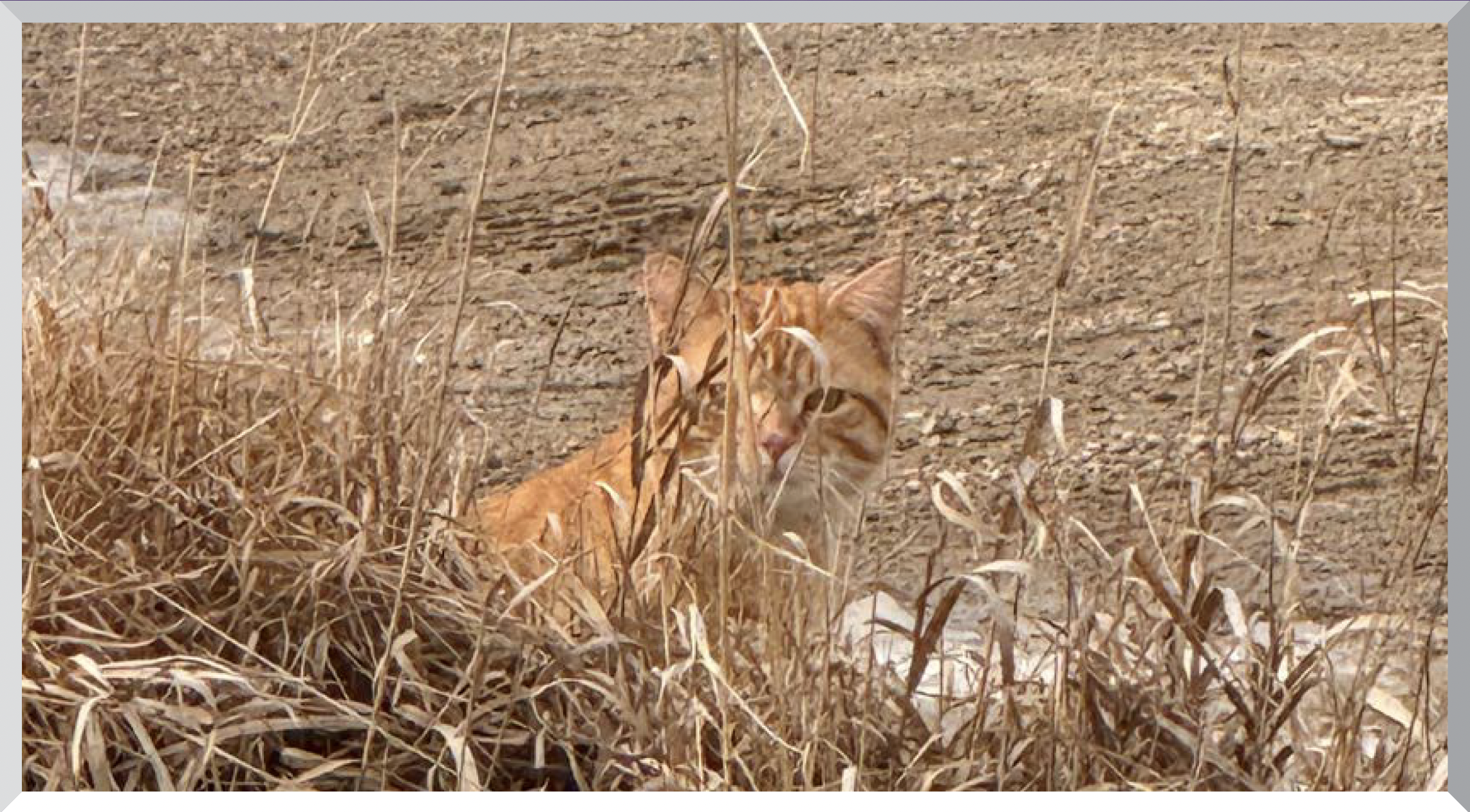
“The image is of an orange tabby cat who is free-roaming. I captured this photo to portray that it isn’t just dogs that free-roam on our reservation.” – Participant 1
Seeing a Community Through Their Own Lens:
Reflections on Photovoice from the Project Manager’s Chair
By: Celeste Morales, Senior Director of Research
Earlier this year, we wrapped up the Red Lake Nation Human and Animal Wellbeing (HAW) study, culminating in a photovoice exhibit held in Red Lake Nation. As I sorted through the photos taken at the event, I was struck again by the powerful imagery. This was my first time leading a photovoice project, and I quickly learned what makes this approach so special. Each image carried something that couldn’t have been captured with a survey or an interview–a way of seeing that is unique to the creator of the image.
I’m sharing what the photovoice process was like from a project manager’s perspective, holding all of the timelines, logistics, and relationships that made the project possible, because it was one of the most rewarding projects I’ve had the privilege of working on in my career.
Why photovoice?
Photovoice is a powerful research and advocacy tool developed by Caroline Wang and Mary Ann Burris in 1997, typically used to explore public health and social justice issues. Photovoice invites participants to take photos of their own lives and communities, and collaboratively reflect on the images and their meanings. It’s a collective storytelling process that informs, engages, and organizes community members to identify community-specific priorities and amplify community-led solutions.Through the photovoice process, lived experience becomes actionable knowledge.
We chose this method because it aligns with our community-based participatory approach to research. We wanted the Red Lake Nation community to tell their stories, from their perspectives.
CARE’s process
Integral to this study was the collaboration between CARE’s Research and Development division, CARE’s Community Animal Care (CAC) division, and several Red Lake Nation community-based organizations (Ombimindwaa, Red Lake Nation College, Red Lake Nation Department of Natural Resources. Awanookwe Kingbird-Bratvold, CARE’s Senior Director of Community Animal Care: Northern Tier, is Ojibwe from the Red Lake Nation in Minnesota. Since 2017, Awanookwe has worked within her community to create a healthy platform to showcase the people’s ongoing love for their awesiinyag (animals) and to highlight Anishinaabe values and cultural teachings. Awanookwe’s proximate leadership was integral to the planning of this project and to inviting other Red Lake Nation community leaders and organizations to join the project as research partners.
As per Awanookwe, the intention was to do this project “in a good way, in the community, and on behalf of the community.”
For CARE, we used photovoice as a storytelling tool to complement the survey and focus group data collected throughout the Red Lake HAW study. Because the broader study’s focus areas were already defined in collaboration with Red Lake Nation community research partners and approved by the Red Lake Nation Tribal Council, we developed the photovoice prompts based on those areas. We recruited photovoice participants using an interest list generated while conducting surveys and focus groups in Red Lake Nation in 2025. In our recruitment efforts, we clearly communicated responsibilities, time commitment, and compensation.
The participants were responsible for engaging in three assignments and taking photos using
their phone or digital camera according to the assignment topic. We held virtual meetings after each assignment, and participants shared their photos and engaged in a structured group dialogue. The project lead summarized the discussion after each meeting and shared the summaries with participants to verify accuracy.
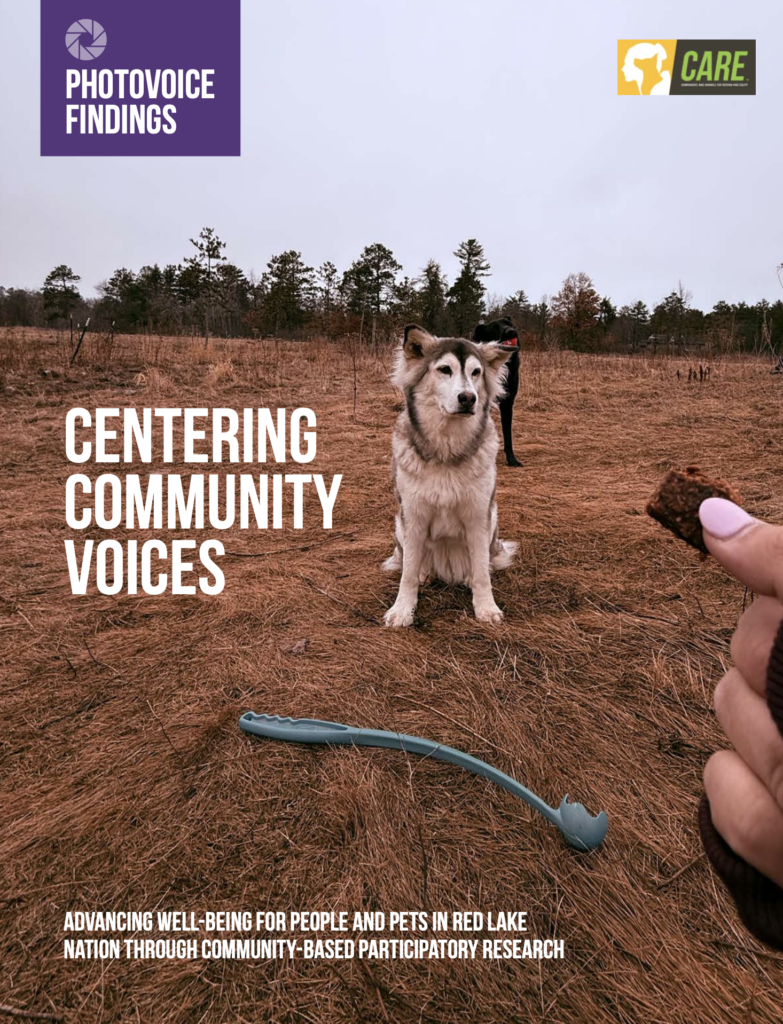
The report detailing the survey and focus group findings, titled ‘Centering Community Voices: Advancing Well-Being for People and Pets in Red Lake Nation through Community-Based Participatory Research’, and the photovoice report, titled ‘Red Lake HAW Report: Photovoice Findings’, are both available through CARE’s Human and Animal Wellbeing Library. Click here to access them.
Now that I’ve set the stage for the ‘why’ and ‘how’ behind our photovoice project, I’ll share what made the photovoice process so powerful.
The power of the images
Photographs say what words can’t. They evoke feelings and emotions. In our group discussions, where the participants gathered to share about the images they took, the photos sparked conversations that might not have otherwise happened. It turned out that the images and their stories were a perfect complement to the survey and focus group data that had already been collected–qualitative data paired with visual storytelling is an impactful combination.
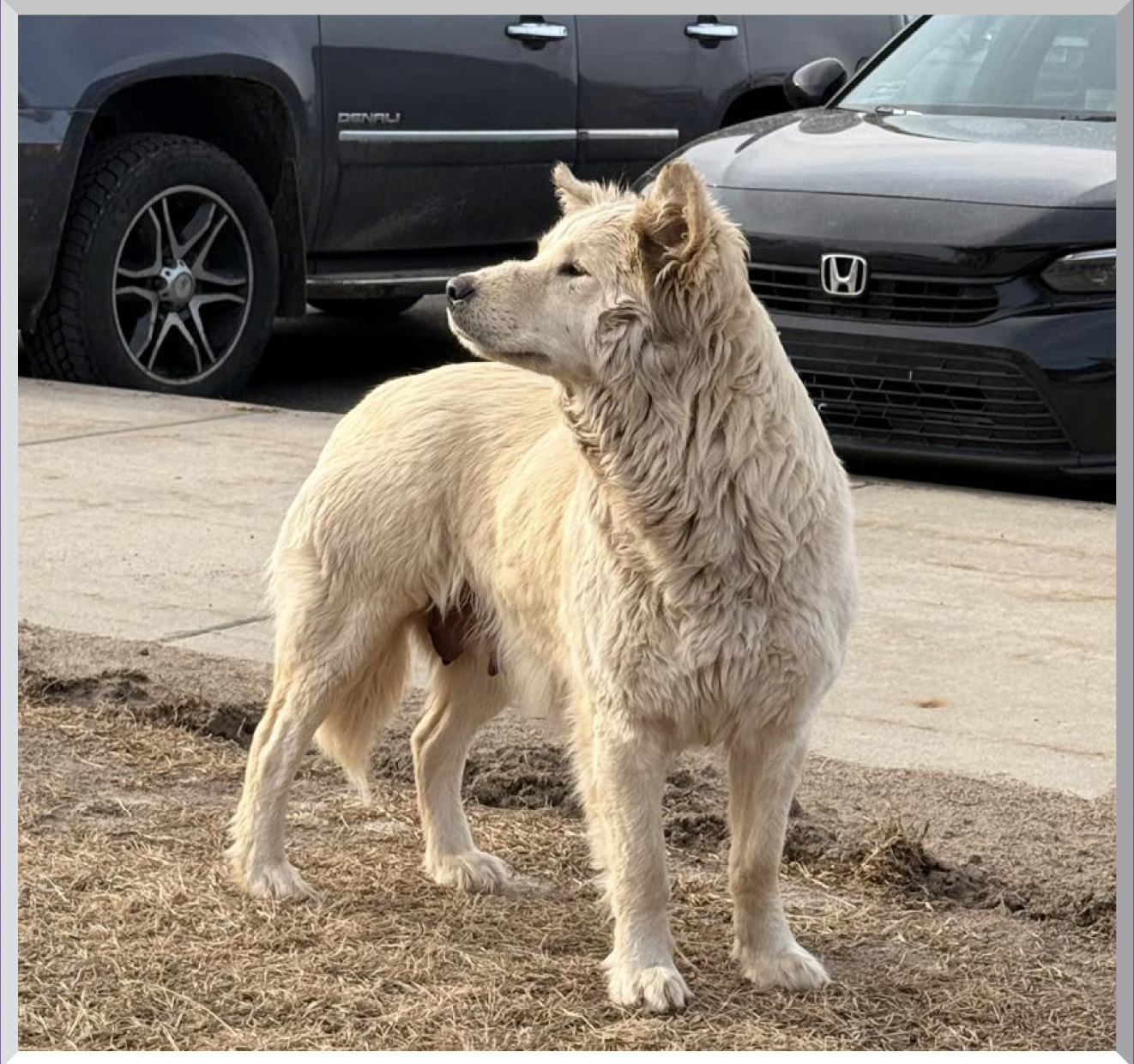
– PARTICIPANT 1
“This photo is of a free-roaming white dog in front of the Tribal
Council building. The reason dogs will free-roam or stay near busy
buildings is due to our community offering food and affection to
animals as they enter or leave the building. This white dog, for
example, has come to learn that busy buildings mean stable food
and, for the most part, kindness.”
Participant-led discussions. The photovoice participants guided the discussions, and the insights were richer because of this. The themes and discussion topics were generated directly from participants. If the conversation went in a particular direction, we followed that thread. A sense of rapport was built over the weeks of the photovoice project that allowed for deeper conversation, which I believe was because of the personal nature of phototaking and storytelling.
Highlighting strengths, not just challenges. We heard from our community partners that it was important for the Red Lake Nation community to tell their stories in their own words, highlight positive stories, and showcase the strengths of the Red Lake Nation community. When stories are told from an outsider’s perspective, we run the risk of expressing a deficit view. While the participants still shared about the challenges in the community and what’s needed, it was in their own voices. The photovoice discussions allowed for a deeper examination of the systemic contexts and barriers at play, and how existing capabilities can be built upon to empower community-led solutions.
Conversations with community. At the photovoice exhibit, community members saw themselves in the images. As the attendees walked through the exhibit, they commented on the familiarity of the images and shared about their similar experiences. Many stopped to chat, telling their own stories and reflections on what the photovoice project had captured. A notepad was provided at the exhibit, where attendees could share their reflections. A few of these reflections included:
“I love all of this. Our pets are part of the community too.”
“I feed 5 dogs at the Ponemah dump. 2 in Ponemah town.
I always have treats and dog food in [my] car.”
– PARTICIPANT 5
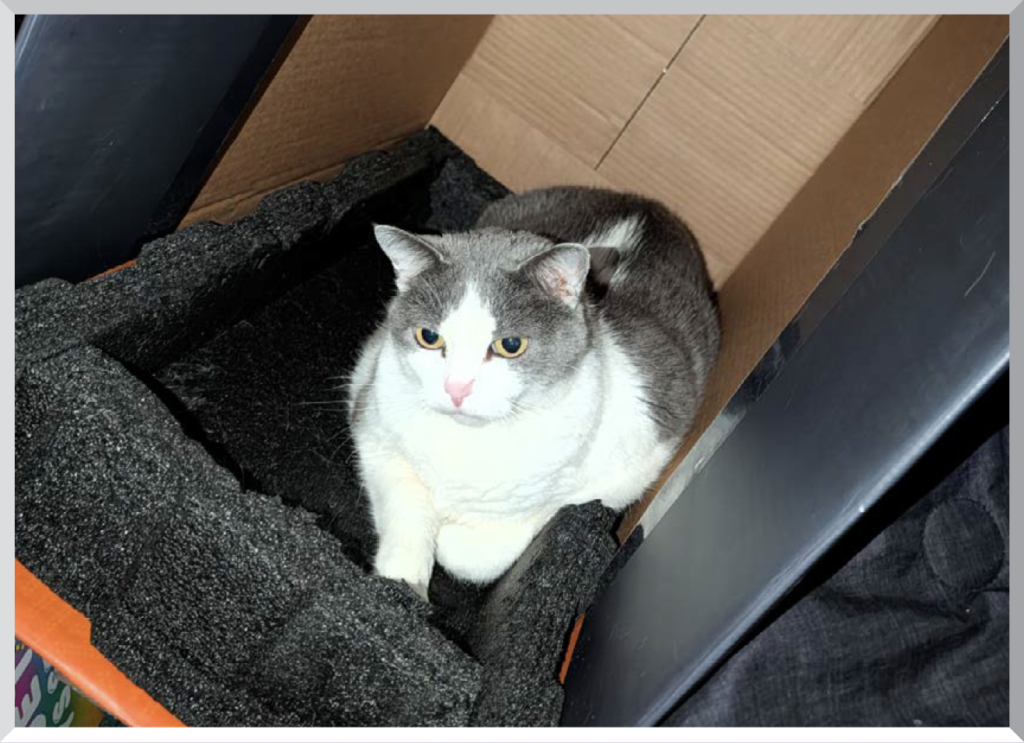
“My son’s senior cat, she has three names and she actually comes to you when you call her either one: ‘Big T’, ‘Teddi’ or ‘Teddibear’. So my son had a homemade bed made for her. It’s a used box with a foam piece pushed inside of it. As you can tell, she is very comfortable with the bed he made her. She sleeps in it pretty much all the time.”
“It shows the realness of the situation that we face w/ over population of unfixed animals”
What the process taught me
As a community-based researcher, photovoice reinforced an essential lesson: relational work takes time. Trust-building and rapport are essential cornerstones of community-based research, and for good reason. Because this photovoice project was the final piece of CARE’s broader Red Lake Human and Animal Wellbeing (HAW) study, it allowed us time to foster relationships. But, I had also already learned that the timeline needs to reflect the relational nature of the work. Before starting the project, we built a timeline and shared it with the participants, making sure that it aligned with their own capacities. If it didn’t, we left space to make adjustments.
What I’d tell a fellow photovoice project manager
- Build in time for trust-building at the beginning of the project and throughout the stages of the research (e.g., design, data collection, dissemination), and make sure funders understand the importance of flexibility within the timeline.
- Define the goals with the community at the outset of the project, and let that guide the public storytelling and dissemination planning.
- Plan enough time for the group discussions, and be present. These discussions shouldn’t be rushed. The conversations are truly where the magic happens.
- Build in time for the dissemination stage. The project doesn’t end once the data are collected and analyzed. This is only the beginning of the collaborative process of data to action.
Photovoice is more than just a research method. It’s a way of honoring and centering lived experience and community wisdom. For those considering photovoice as a community-based research tool, I recommend bringing your curiosity, flexibility, and openness to the process.